2026 Bone Conduction and Open-Ear Audio Strategic Analysis: A Comprehensive Procurement and Risk Mitigation Framework
The global landscape of personal audio in 2026 has been fundamentally reshaped by a move away from total acoustic isolation toward situational awareness. This transition, described by industry analysts as the "Open-Ear Revolution," has seen bone conduction technology evolve from a niche utility for elite marathoners into a mainstream consumer preference for urban commuters, office professionals, and multi-sport athletes. As of early 2026, the market for these devices is projected to grow at a Compound Annual Growth Rate (CAGR) exceeding 24%, reaching an estimated valuation of $5.34 billion USD by 2034. This report provides a detailed technical evaluation of the 2026 hardware ecosystem, analyzes user sentiment regarding long-term reliability, and establishes a definitive framework for identifying fraudulent market entries that have proliferated alongside the technology's popularity.
The Technical Evolution of Bone Conduction in 2026
The core mechanism of bone conduction has remained consistent since its inception, yet the engineering refinements observed in 2026 have addressed historical limitations in audio fidelity and user comfort. By converting electrical signals into mechanical vibrations that bypass the tympanic membrane (eardrum) to stimulate the cochlea directly through the temporal bone, these devices offer a unique safety advantage. The sound transmission path—comprising the sound wave, cranium, bone labyrinth, inner ear lymph, spiral organ, auditory nerve, and cerebral cortex—ensures that the external auditory canal remains entirely unobstructed.
Hybrid Transduction and the "DualPitch" Revolution
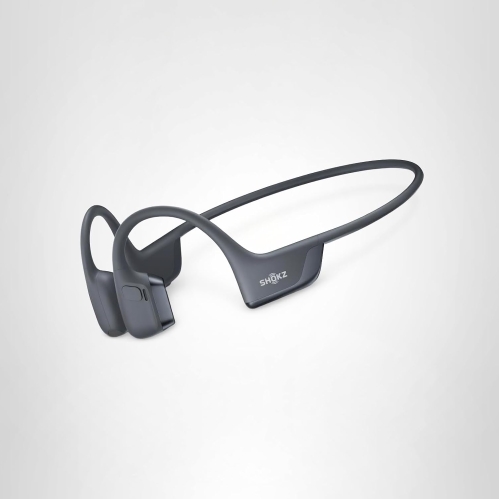
The most significant technical advancement in the 2026 flagship models, such as the Shokz OpenRun Pro 2, is the implementation of hybrid transduction. Historically, bone conduction struggled to replicate low-frequency "bass" notes because the energy required to vibrate the skull at low frequencies often resulted in an uncomfortable "tingle" or tickling sensation on the skin. To resolve this, 2026 premium models utilize a dual-driver system. A bone conduction transducer manages the high and mid-range frequencies where clarity is paramount, while a dedicated air conduction (directional audio) speaker handles the low-end frequencies. This hybrid approach has allowed premium units to achieve a frequency response range of 20Hz to 20kHz, comparable to mid-tier traditional earbuds.
Strategic Comparison of Open-Ear Modalities
In 2026, consumers must distinguish between true bone conduction and the emerging "open-air" or "directional audio" category. While both keep the ear canal open, their applications and technical constraints differ significantly.
| Technical Attribute | True Bone Conduction (Neckband) | Directional Air Conduction (Clip-on/Hook) |
|---|---|---|
| Transmission Medium | Cranial Bone Vibration | Directed Sound Waves in Air |
| Acoustic Profile | Mid-focused, high clarity | Balanced, richer bass response |
| Environmental Seal | Typically higher (IP67/IP68/IP69) | Typically lower (IP54/IP55) |
| Submerged Performance | Excellent (via MP3 mode) | Ineffective |
| Leakage Control | Mechanical (Physical contact) | Acoustic (Phase cancellation) |
| Best Use Case | Swimming, high-impact running | Office, casual cycling, lifestyle |
Analysis of the 2026 market indicates that while directional audio is preferred for media consumption in quiet environments, true bone conduction remains the "gold standard" for safety-critical and extreme environments.
2026 Flagship Hardware: A Comparative Evaluation
The competitive landscape in 2026 is dominated by four primary entities: Shokz, Suunto, Nank, and Mojawa. Each has optimized its hardware for specific user demographics, from the "ultra-endurance" adventurer to the "leisure-focused" urbanite.
The Shokz Ecosystem: Market Leadership and Standardization
Shokz continues to hold approximately 65% of the global market share in 2026. Their flagship, the OpenRun Pro 2, has set the industry standard by finally adopting USB-C charging, moving away from the proprietary magnetic cables that plagued previous generations.
Technical Performance of the OpenRun Pro 2
-
Acoustic Architecture: The "DualPitch" system provides what many reviewers consider the best sound quality in the bone conduction category, characterized by punchy mid-range and reduced distortion at high volumes.
-
Power Management: The device offers 12 hours of battery life, a 20% increase over its predecessor, with a 5-minute fast charge providing up to 2 hours of additional playtime.
-
Ergonomics: Utilizing a titanium alloy frame wrapped in high-grade silicone, the unit weighs roughly 30g, providing a secure fit that remains stable during lateral movements or sprinting.
Suunto Wing 2: The Adventure Benchmark
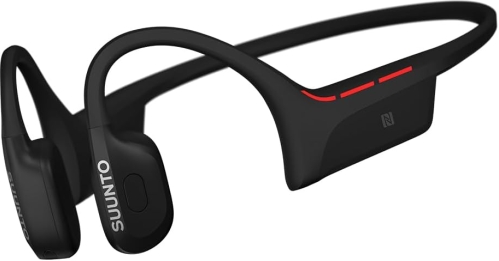
Suunto released the Wing 2 in late 2025 as a direct challenge to Shokz's dominance in the outdoor endurance market. The Wing 2 is engineered for "extreme situational awareness" and multi-day outings.
Key Differentiators for the Wing 2
-
Extended Endurance: While the headset itself provides 10–12 hours of playback, it ships with a portable power bank that adds another 24 hours of capacity, making it the preferred choice for ultra-marathoners.
-
Safety Integration: Red LED strips on the side of the unit can pulse or flash based on user movement, significantly increasing safety for night runners and cyclists.
-
Head Movement Control: An innovative sensor suite allows users to interact with the device without using their hands. A single nod can answer a call, while a shake of the head can skip a track, a feature particularly useful in cold climates where users wear heavy gloves.
Nank Runner Diver2 Pro: Technical Dominance in Aquatic Environments
Nank (also known as Naenka) has focused on the "hardcore" aquatic segment. The Runner Diver2 Pro is the first bone conduction headset in 2026 to achieve an IP69 rating, allowing it to withstand high-pressure, high-temperature water jets and submersion up to 10 meters for 5 hours.
| Feature | Nank Runner Diver2 Pro | Shokz OpenSwim Pro |
|---|---|---|
| Waterproof Rating | IP69 (Extreme) | IP68 (Standard) |
| Internal Storage | 32GB (8,000 songs) | 16GB–32GB |
| Connectivity | Bluetooth 5.4 + MP3 | Bluetooth 5.3 + MP3 |
| Sound Profile | Bass-heavy, loud | Balanced, clear underwater |
| Adjustment | 35∘ Adjustable Earhook | Fixed Frame |
| Price (Estimated) | 159–199 USD | 199–229 USD |
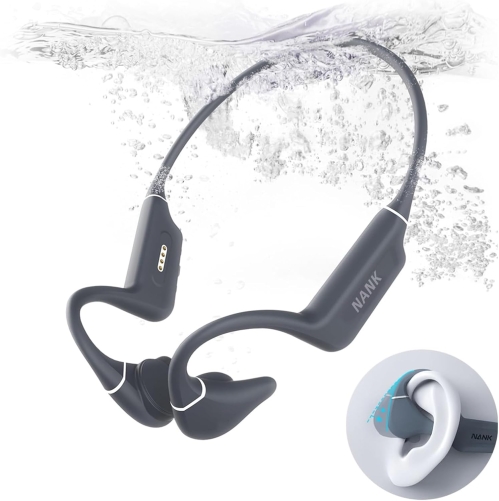
Technical analysis suggests that while Shokz provides a more "refined" and lightweight feel (27g vs. 32\g), the Nank model offers superior durability and a more secure fit for swimmers who do not use swim caps.
The Rise of Clip-on and Open-Ear Lifestyle Designs
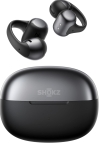
A major pivot in 2026 is the proliferation of "clip-on" earbuds, such as the Shokz OpenDots ONE and the Bose Ultra Open. These devices eschew the wraparound neckband in favor of a "cuff" design that clips to the outer ear.
OpenDots ONE: The New Lifestyle Standard
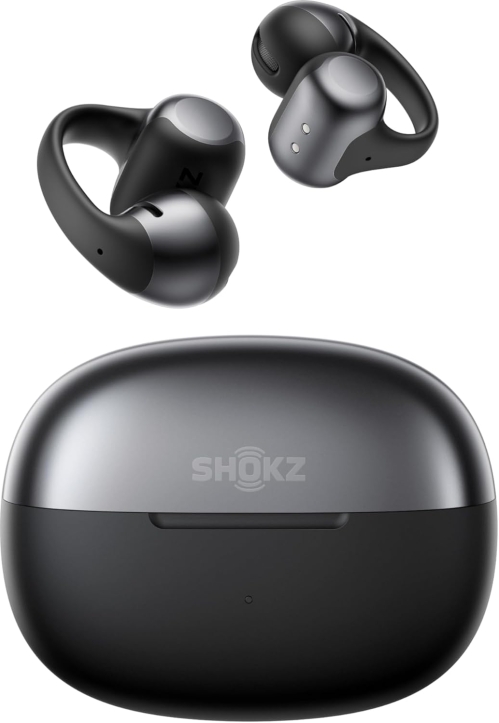
The OpenDots ONE represents Shokz's entry into the non-sport, "all-day accompanying device" market. These utilize DirectPitch technology to project sound into the ear canal without covering it.
-
Audio Fidelity: They feature 11.8mm drivers and support Dolby Audio, providing a spatial soundstage that bone conduction units cannot match.
-
Battery Life: Each bud offers 10 hours of playtime, with the charging case providing a total of 40–50 hours. This significantly outclasses the 27-hour total runtime of the more expensive Bose Ultra Open.
-
Usage Context: These are ideal for office environments where users need to hear colleagues or for "light jogging," but they are less secure than neckband models for vigorous HIIT or trail running.
The Open-Ear Noise Reduction Debate
In early 2026, Shokz introduced "OpenEar Noise Reduction" in the OpenFit Pro model. This technology is distinct from traditional Active Noise Cancellation (ANC). While ANC requires a physical seal to create a quiet environment, Open-Ear Noise Reduction uses a triple-microphone array and algorithms to damp external sounds by 12dB to 16dB.
-
Environmental Effectiveness: This tech is successful in neutralizing mid-frequency hums (like HVAC systems or office chatter) but fails in high-noise environments like airplanes or subway stations.
-
Energy Consumption: Engaging noise reduction reduces the battery life from 12 hours to 6 hours, a significant trade-off that indicates the technology is still in its "early adopter" phase in 2026.
Reliability Analysis: Sweat Damage and Failure Rates
Despite improvements in IP ratings, long-term durability remains a concern in the 2026 market. User reports from platforms like Reddit highlight a recurring "sweat damage" phenomenon, particularly among "heavy sweaters" who exercise in high-humidity climates.
Charging Port Corrosion and Failure Modes
Most swimming and high-waterproof models rely on proprietary magnetic two-pin connections. While these ensure a seal, they are susceptible to corrosion if salt or chlorine residue is not removed.
-
The 12-Month Threshold: Data shows that a significant percentage of units fail within 6 to 12 months if subject to daily heavy sweat without cleaning.
-
Warranty Importance: In 2026, Shokz remains the leader in customer loyalty due to its 2-year warranty and high replacement rate for units that "short out" due to moisture.
-
Maintenance Protocol: Professional athletes are advised to rinse their headsets with fresh water and wipe the charging pins dry with a soft cloth after every session to prevent electrochemical corrosion.
Risk Mitigation: Identifying Scams and Counterfeit Hardware
The surge in open-ear popularity has led to a sophisticated ecosystem of fraudulent brands. Identifying these requires an understanding of both the technology and the deceptive marketing tactics used on platforms like Amazon, AliExpress, and specialized scam websites.
The "Inductivv" and "Fake Review" Networks
Scam entities often create a dozen "product review" sites that all point to a single fraudulent brand, such as "Inductivv" or similar generic names.
-
The Deception: These sites advertise "breakthrough" bone conduction for $50–$60 USD, often claiming it is a "clearance sale" or "limited time offer".
-
The Reality: Victims receive cheap $15 USD Bluetooth headsets with standard external speakers. These devices "leak" sound to everyone in the vicinity and provide no bone conduction benefit.
-
Logistical Manipulation: When customers complain, scammers offer a 50% refund to avoid a chargeback, knowing that most consumers will accept the loss to avoid the hassle of an international return.
The Definitive "Anti-Scam" Verification Framework
To ensure the authenticity of 2026 hardware, procurement officers and consumers should employ three specific diagnostic tests.
1. The Occlusion Verification Test (The "Ear-Plug" Test)
This is the most scientifically accurate method to verify true bone conduction. Because bone conduction bypasses the outer ear, blocking the ear canal creates the "occlusion effect," where internal vibrations are amplified.
-
Procedure: Play audio at a moderate volume. Place your fingers in your ears or use earplugs to seal the canal completely.
-
Authentic Result: The sound will become louder and clearer. This confirms the sound is traveling through the skull.
-
Fraudulent Result: The sound will become muffled, distant, or inaudible. This indicates the device is using standard air-conduction speakers.
2. The Transducer Contact and Leakage Test
Examine the pads that make contact with the face. True bone conduction transducers require a solid surface to transmit mechanical energy.
-
Visual Indicators: Real units have smooth silicone or rubber pads with no mesh, grilles, or speaker holes. If you can see a "speaker hole," it is air conduction.
-
Leakage Benchmark: While some sound leakage is normal due to the vibration of the headset's frame, a person standing 1 meter away should not be able to follow the lyrics of your music at 50% volume.
3. The Price and Brand Threshold
In 2026, the manufacturing cost of quality bone conduction transducers (which require rare-earth magnets and precision engineering) remains high.
-
Price Red Flags: Any "bone conduction" headset priced under $40 USD is statistically likely to be a fake.
-
Entity Verification: Buyers should stick to established entities like Shokz, Suunto, Nank, Mojawa, Philips, or Creative. Generic brands with no history or technical documentation are high-risk.
Strategic Procurement: Matching Hardware to User Profiles
Effective selection in 2026 requires matching the specific waterproof, storage, and acoustic needs of the user to the hardware's engineering focus.
The "Avoid" List (2026 Risk Areas)
-
Generic Amazon "Knock-offs": Typically fail within 30 days due to poor sweat-proofing.
-
Suunto Wing (Original): While good, the 2026 market favors the Wing 2 for its improved USB-C charging for the power bank and better driver tuning.
-
Shokz OpenRun Pro (Gen 1): In 2026, this model is deprecated by the Pro 2. The lack of USB-C and inferior bass response makes it a poor investment at its remaining retail price.
The Future Outlook: 2027 and Beyond
Industry trends observed at CES 2026 suggest that the next frontier for open-ear audio is the integration of AI-driven biometrics and the convergence with smart glasses.
-
AI Integration: Devices like the Mojawa HaptiFit Terra already incorporate heart rate monitoring and "AI Sports Trainers" that provide real-time performance feedback.
-
Smart Glasses Convergence: Shokz and JBL have previewed early-stage smart glasses that integrate bone conduction into the frames, providing a completely "invisible" audio experience for urban explorers.
-
Spatial Audio Dominance: The success of Dolby Atmos in the OpenDots ONE suggests that spatial audio will become a standard requirement for all premium open-ear devices by 2027.
Conclusion: Navigating the 2026 Audio Landscape
The 2026 bone conduction and open-ear market offers unprecedented choice, yet it requires a more discerning buyer than in previous years. The technological "sweet spot" has shifted toward hybrid designs that balance safety with respectable audio quality. To ensure a successful purchase and avoid "IQ taxes" (scams), procurement must prioritize established brands, verify IP ratings against actual use cases (swimming vs. running), and employ the "Occlusion Verification Test" as a mandatory quality control step. By following the technical benchmarks and anti-fraud protocols outlined in this report, users can leverage the absolute advantages of open-ear audio—safety, hygiene, and comfort—while minimizing the risks inherent in a rapidly expanding technological segment.